


Buy your weekday smoothies and get your weekend ones for free. (7 for the price of 5!)
WELLNESSWEEK

Last Updated: 8 November 2026
Quick Summary
A natural alternative to retinol is a plant-derived ingredient or botanical oil used to support fine lines, uneven tone and dullness without synthetic vitamin A. Bakuchiol, extracted from the babchi plant, is the one most often compared with retinol. Results tend to be slower and quieter, so patience and a patch test matter.
Many Australian women reach for a natural alternative to retinol because their skin has told them something. Maybe retinol left it red, flaky and tight. Maybe the skin feels too reactive for a strong active, or the idea of a daily vitamin A derivative simply doesn't sit right with a more botanical way of caring for yourself. It deserves a gentle, honest answer.
A natural alternative to retinol is a plant-derived ingredient or botanical oil that people use to support the look of fine lines, uneven tone and dullness, without relying on synthetic vitamin A. These options tend to work more slowly and more quietly. That, for many people, is the point.
Here is what we'd like you to hold onto as you read on: "natural" is a starting place, not a guarantee. Every ingredient still needs patience, a patch test and a steady routine.
Bakuchiol is the botanical compound most people mean when they ask about a natural retinol alternative. It is extracted from the seeds and leaves of the babchi plant (Psoralea corylifolia), a herb long used in Ayurvedic and traditional Chinese medicine. In skincare, it has become the ingredient most often set beside retinol in conversations about gentle renewal.
The reason is simple. Bakuchiol is frequently discussed for its role in supporting a smoother-looking texture, which is part of why it turns up so often in these comparisons.
Here is where we like to slow down and be careful. Bakuchiol has been studied, but the strength and scope of that research varies, and it is worth reading any claim with a curious eye. Look for studies on human skin, check how long they ran, and notice whether the results come from the ingredient itself or from a finished product.
The formulation matters as much as the ingredient, so we would rather you trust a modest, honest picture than a dramatic promise.
Concentration and formulation are where the real story lives. Look for the percentage if it is stated, and check where bakuchiol sits in the ingredient list, ingredients are listed in descending order of concentration until 1%, after which order is less strict.
We would rather you trust a modest, honest picture than a dramatic promise.
The article sets out the key facts about bakuchiol at a glance:
Fact |
Detail |
Note |
|---|---|---|
Source |
Babchi plant (Psoralea corylifolia) |
Seeds and leaves |
Traditional use |
Ayurvedic and traditional Chinese medicine |
Long-standing herbal use |
Common comparison |
Retinol |
Often discussed for smoother-looking texture |
Label check |
Concentration and ingredient order |
Ingredients listed by descending concentration |
Suitability |
Not automatically suitable for everyone |
Patch test first if reactive |
Plant oils often sit alongside bakuchiol in a natural routine, and three come up again and again: rosehip, carrot seed and sea buckthorn. Each brings its own character, and each is best understood as a supporting player rather than a replacement for a single active.
Rosehip oil is widely used for its nourishing feel. Carrot seed oil is a rich, earthy botanical. Sea buckthorn is a bright, golden oil.
Our own Daily Face Oil - Barrier Support brings a related set of botanicals together, with cold-infused Australian Certified Organic hemp seed oil, chamomile, calendula and lavender, along with rosehip CO₂ extract and natural vitamin E. You can see how it's put together on the Daily Face Oil product page.

If your skin reacts to almost everything, this is the section to read slowly. Sensitive skin doesn't need you to be brave. It needs you to be patient, and it needs you to know which botanicals are more likely to sting and which are more likely to soothe.
Not all natural ingredients are gentle. Some plant extracts contain compounds that can irritate reactive skin, especially when used at high concentrations or left on the skin. Essential oils can be a common source of irritation for some people. Fragrance, whether synthetic or natural, can also trigger reactions. Even some popular botanicals like witch hazel (especially with alcohol) and certain fruit extracts can be too astringent for compromised skin.
Daily Face Oil - Barrier Support →
If you are pregnant or breastfeeding, check with your healthcare provider before using any new active, including botanical ones. Some essential oils and plant extracts are not recommended during pregnancy, and it is always better to ask than assume.
On the gentler side, look for oils rich in fatty acids and soothing botanicals, such as rosehip oil, sea buckthorn and calendula or chamomile infusions. Hemp seed oil is another kind option. These are not actives in the retinol sense.
Start with one new ingredient at a time. Patch test on a small area of your jawline or inner arm for several days before using it across your face. Keep the rest of your routine simple and gentle while you introduce something new, so that if your skin does complain, you know what caused it.
Look at the full ingredient list, not just the headline botanical. Fragrance, essential oils and certain acids can irritate reactive skin even when the star ingredient is kind. If you have a condition such as eczema, rosacea or persistent sensitivity, check with a doctor or dermatologist before adding a new active, and treat any natural product as something to test, not assume.
For a closer look at botanical oils suited to reactive skin, our guide The Best Oils For Rosacea And Sensitive Skin walks through the options with the same gentle approach.
Bakuchiol is usually introduced at night, after cleansing and before a richer oil or moisturiser. Begin with a few drops, warm them between your palms, and press them gently into your skin. For a closer look at how a daily face oil ritual is structured in practice, see the Daily Face Oil Ritual page.
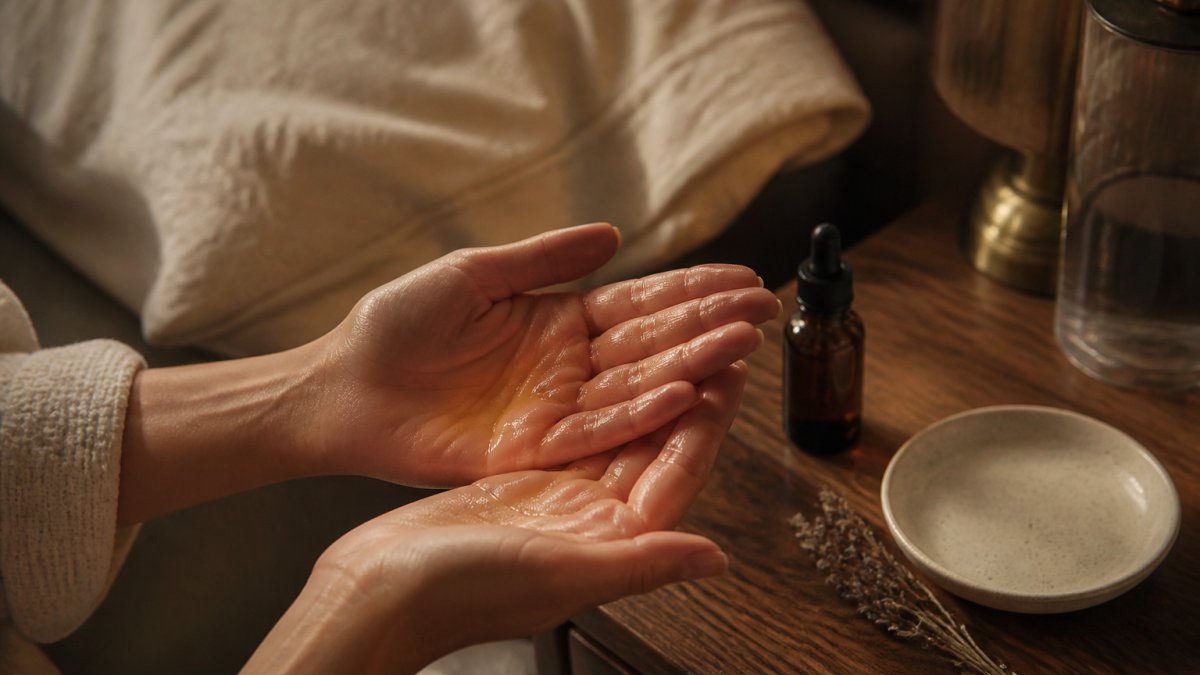
Give it time. Consistency matters far more than intensity. Sun protection in the morning is still a sensible part of any routine.
A simple ritual makes this easier to stick with. Smooth the oil on in upward strokes, take a slow breath, and let the moment be part of the care.
Ready to build the whole evening step? The Nightly Face Oil is a restorative facial oil for this moment.

If you are new to natural retinol alternatives, you don't need a cabinet full of products. Start with a cleanser, a gentle hydrating layer and one night oil. Once that feels familiar, you can add a targeted active if you want to.
A beginner-friendly order often looks like this: cleanse, mist or tone, apply a facial oil, then finish with moisturiser if your skin feels dry. Keep it to three or four steps so your skin has room to respond.
For a complete framework to follow step by step, our guide Natural Anti Ageing Face Routine 2026: A Complete Guide lays out how to layer botanicals gently over time.
The most widely discussed natural equivalent to retinol is bakuchiol, a plant-derived compound from the babchi plant. It is often presented as a retinol alternative because it is studied for similar goals such as the look of fine lines and uneven tone, while being gentler on the skin. Plant oils such as rosehip, carrot seed and sea buckthorn are also used in natural routines. None of these is a direct chemical match for retinol, so set expectations accordingly and give your skin time to respond.
The honest answer is that the evidence is more limited than for retinol. Some small studies have reported improvements in fine lines and skin texture with bakuchiol, and it is often chosen because it tends to cause less irritation. Retinol has a much larger body of research behind it. Bakuchiol may suit people who cannot tolerate retinol, but it is best understood as a different, gentler option rather than a guaranteed equal.
For sensitive skin, many people start with a simple, single-ingredient approach and introduce one product at a time. Always perform a patch test on a small area of skin for several days before using a new product across your face, and stop if you notice persistent redness, stinging or itching. If you have a diagnosed skin condition, check with your GP or dermatologist first.
Use them in your evening routine after cleansing and toning, while the skin is still slightly damp. Warm a few drops of oil between your palms and press gently into the face and neck. Use sunscreen by day, as skin can be more sensitive to sun exposure with active ingredients, and keep the ritual calm and unhurried.
Choosing a natural alternative to retinol is really about choosing how you want to care for your skin, and yourself, over time. Start slowly, test with patience, and let your routine become a small daily act of kindness. When you're ready to bring the evening ritual together, our Nightly Face Oil | Restorative Facial Oil is a natural place to begin, and the Day & Night Duo pairs it with its daytime companion for a full cycle of care.

